

August continues to be an exciting month for sky-gazers.
Closely following the peak of the
Perseid meteor shower last week, the first of the year’s four
consecutive supermoons is set to rise on August 19. The rare cosmic combination
of a supermoon and blue moon peaks at 2:26 p.m. ET Monday.
The last time this lunar event occurred was August 2023, and
the next super blue moons are projected for January and March of 2037.
Approximately one-quarter of all full moons are supermoons, while a mere 3% of full moons are blue moons.
So-called supermoons appear as the biggest and brightest
lunar events of the year. The moon’s orbit around Earth is not a perfect circle
but an elliptical path. Scientists refer to the moon’s nearest point to Earth —
an average distance of about 226,000 miles (363,300 kilometers) — along its
27-day journey as the satellite’s perigee, according to
NASA.
There are varied definitions for supermoons, said Noah
Petro, lab chief of NASA’s Planetary Geology, Geophysics and Geochemistry lab.
However, a full moon within 90% of perigee is often described as a supermoon,
he said.
When the moon is closest to Earth in its orbit, it can
appear up to 14% larger and 30% brighter than when it’s at its farthest point
from the planet, known as apogee, about 251,000 miles (405,500 kilometers) from
Earth.
Supermoon visibility
Supermoons are observable to the naked eye and do not
require a particular location for viewing. Throughout the night, the moon will
rise higher until just before sunrise.
Shannon Schmoll, director of Abrams Planetarium at Michigan
State University, said if the sky is free of clouds and you have a clear view,
you will be able to see the moon.
“It’s bright enough that you don’t need to go anywhere
special,” and visible right after the sun sets, she said.
Petro said the joy of these full moons is that if cloud
coverage obscures visibility, you can look any night before or after the full
moon peaks.
“So there’s really three days where the full moon is going
to be most beautiful,” he said.
“The thing about these super moons is because they’re so
much closer, they’re also brighter.” He noted that if it’s a clear night, you
may notice the shift in brightness outside. “You’ll be treated to this
beautiful sight in the sky, which is our moon hovering off in the distance.”
Because supermoons are 30% brighter than average full moons,
they are more easily detectable.
Supermoon visibility
Supermoons are observable to the naked eye and do not
require a particular location for viewing. Throughout the night, the moon will
rise higher until just before sunrise.
Shannon Schmoll, director of Abrams Planetarium at Michigan
State University, said if the sky is free of clouds and you have a clear view,
you will be able to see the moon.
“It’s bright enough that you don’t need to go anywhere
special,” and visible right after the sun sets, she said.
Petro said the joy of these full moons is that if cloud
coverage obscures visibility, you can look any night before or after the full
moon peaks.
“So there’s really three days where the full moon is going
to be most beautiful,” he said.
“The thing about these super moons is because they’re so
much closer, they’re also brighter.” He noted that if it’s a clear night, you
may notice the shift in brightness outside. “You’ll be treated to this
beautiful sight in the sky, which is our moon hovering off in the distance.”
Because supermoons are 30% brighter than average full moons,
they are more easily detectable.

“If you take a season, a season is about three months long.
So in that time, you would normally have three full moons in a single season,
and if you end up with four in a season, the third one of the four would be the
blue moon, and that’s what this blue moon is,” Schmoll said.
In the 1930s, the Maine Farmer’s Almanac started applying
names corresponding to events in nature for the full moons, Petro said. These
names have since become widely used and recognized. “Sturgeon moon originates
from indigenous observations within the environment,” he said.
Maine Farmer’s Almanac states that the Algonquin tribes, who
once lived in what is now the northeastern region of the United States,
referred to the full moon in August as the sturgeon moon, named after the large
fish caught more readily during this season.
Upcoming celestial events
Keep an eye out for Jupiter and Mars while peering at the
moon, Schmoll said.
Last week, the two planets were aligned in conjunction,
reaching their closest proximity to each other from Earth’s viewpoint since 2018. Jupiter and Mars will likely remain fairly
close to one another in the sky during the supermoon’s peak, Schmoll said.
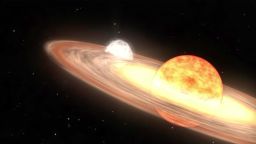
And in the next month or so, anticipate a brightening event,
known as a nova, that will occur in the Milky Way’s Corona Borealis, or
Northern Crown constellation. Astronomers expect T Coronae Borealis, nicknamed Blaze Star, to
explosively burst as a binary system of a dead white dwarf star and an aging
red giant star violently collapse.
“There’ll be what looks like a new star in the constellation
for a few days to a week before it fades from view. And this is something that
happens every 80 years or so,” Schmoll said. “That’s something that we don’t
know exactly when it’s going to happen, but we are expecting it to happen.”
Schmoll said.
Remaining supermoons of the year
The remaining supermoons of 2024 will occur on September 18,
October 17 and November 15.
The September supermoon will also be a partial lunar eclipse, meaning Earth will cast its shadow
over part of the moon, Petro said. “It’s a partial one, so it’s not going to be
as obvious to a viewer,” he said.
The fullest, largest moon of the year will rise in October.
“The moon will actually be about 100 kilometers (62 miles) closer to the Earth
on October 17,” Petro said.



0 Comments